
Helping Your Kids Know God’s Design: A Deep Dive into Biblical Conversations on Sexuality and Gender

Parents today are raising kids in a sex‑saturated culture, but God has not left us without guidance or hope. This episode of Pure Sex Radio with guest Elizabeth Urbanowicz offers biblically grounded, practical help for moms and dads who want to shepherd their children toward sexual wholeness in Christ.
Meeting Elizabeth Urbanowicz
Elizabeth Urbanowicz did not set out to become an expert on helping kids think biblically about sexuality. She began as a third‑grade teacher at a Christian school near Chicago and quickly saw a troubling gap in her students’ discipleship.
Her students knew Bible stories, verses, and came from solid Christian homes, but they struggled to connect biblical truth to what they were seeing in books, online, and on the playground. They lacked the skills to evaluate cultural messages through a biblical lens.
When Elizabeth couldn’t find age‑appropriate resources, she created an after‑school class to teach 3rd–5th graders to think critically and biblically about everything. The transformation in those kids drew interest from parents and leaders around the country, which eventually led Elizabeth to earn a master’s degree in Christian apologetics and launch Foundation Worldview, a ministry equipping adults to disciple children’s minds and hearts.
As her ministry grew, one category of questions kept rising to the top:
When should I have “the talk” with my child?
How do I explain a same‑sex relationship in our family?
What do I do when my child encounters pornography?
How do I respond when a loved one identifies as another gender?
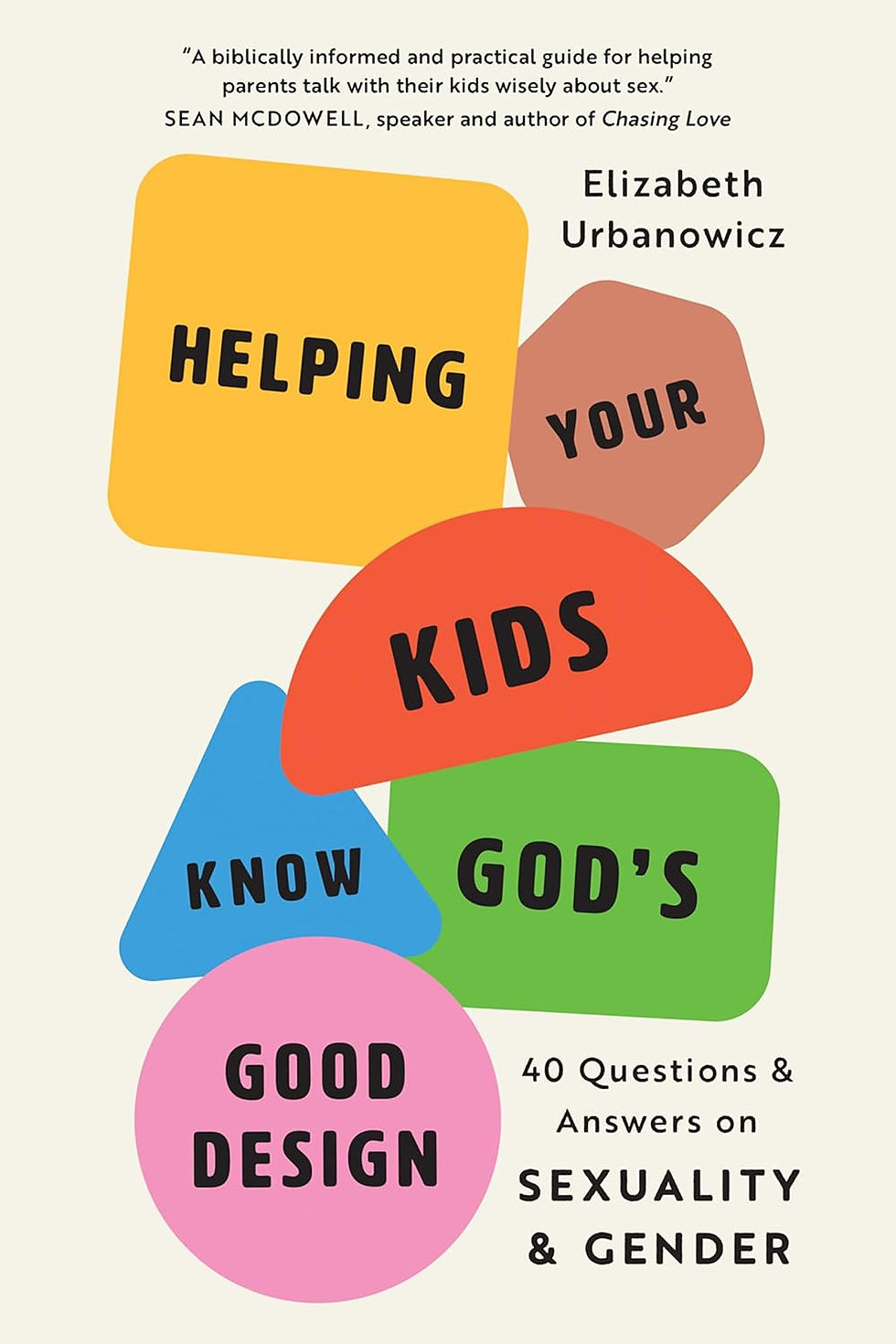
Those repeated questions became the seed for her book, Helping Your Kids Know God’s Good Design: 40 Questions & Answers on Sexuality and Gender. After turning down a publisher’s invitation three times, Elizabeth eventually said yes, seeing the need for a practical, biblically grounded resource parents could pull off the shelf anytime a tough topic surfaced.
God’s Good Design for Sex and Marriage
Before we talk about “the talk,” Elizabeth urges parents to step back to the 30,000‑foot view of God’s design. Sexuality is far too significant to be squeezed into one awkward conversation; it’s meant to be an ongoing discipleship journey.
She highlights three core biblical principles:
What marriage is
Scripture presents marriage as a lifelong covenant between one man and one woman who become one flesh for life. This pattern begins in Genesis 2, where God brings Eve to Adam and Moses declares that a man will leave his father and mother and be united to his wife. Jesus affirms this in Matthew 19, and Paul echoes it in Ephesians 5, tying marriage directly to Christ and the church.
What sex is for
God designed sex as the act that seals the marriage covenant, giving it as a gift to husbands and wives to deepen intimacy and, ordinarily, to create children. In Scripture, sexual union is tied to intimate “knowing” and often directly connected to the gift of new life.
What falls outside God’s design
All sexual expression outside the one‑man, one‑woman marriage covenant is sin. From Genesis onward, the Bible shows how quickly humanity distorts God’s good gift and then catalogs sexual sins in places like Leviticus 18–19.
Parents must first grasp this framework for themselves before they can faithfully pass it on. We are not just telling our kids what God forbids; we are inviting them into His very good design.

Marriage, Singleness, and the Ultimate Relationship
One of the most helpful parts of the conversation is Elizabeth’s insistence that we must not accidentally turn marriage into an idol. While marriage is a beautiful gift and the Bible’s favorite metaphor for God’s covenant love, it is still a shadow pointing to a greater reality: Christ and His church.
Speaking as a single woman, Elizabeth describes wrestling with this personally. She realized she might never experience the earthly “shadow” of marriage, but she will never miss out on the reality—union with Christ. That realization is vital for our kids, including those who remain single, lose a spouse, or simply struggle to fit the “marriage‑centric” picture they see in church culture.
Elizabeth suggests two simple catechism‑style phrases to teach children:
From Genesis 2: “Marriage is one man and one woman becoming one flesh for life.”
From Ephesians 5: “Marriage is a picture of Jesus and the church.”
This helps kids see that the goal of both marriage and singleness is the same: to point to the gospel. Married couples picture Christ and the church through sacrificial love and godly leadership and submission, while single believers testify that Christ alone is enough and lay their sexual desires before Him in worship.
Talking about Masturbation and Pornography
In Be Broken Ministries’ work with men, women, and families, questions about masturbation and pornography surface constantly. Elizabeth models how to address both with clarity, compassion, and Scripture‑rooted reasoning.
How to think biblically about masturbation
The Bible never uses the word “masturbation,” but it says a great deal about God’s purpose for sex. Elizabeth returns to the three purposes of sex—intimate knowing between spouses, creating children, and picturing Christ and the church—and holds masturbation up against them.
A person alone, self‑stimulating:
Does not deepen intimate knowledge between husband and wife.
Cannot create children according to God’s design.
Does not picture Christ’s union with His church.
Because it fits none of God’s stated purposes for sex, masturbation falls outside His good design. When teaching children, she recommends walking them through Scripture (Genesis 2, Ephesians 5) and helping them make that connection themselves so they see this is about honoring God’s design, not just obeying an arbitrary rule.
Also, when a preteen’s changing body leads to curiosity without conscious lust, God is not standing over them with instant condemnation—but that very ignorance reveals the need for instruction. Many adults who want to justify ongoing masturbation are really asking, “Can you tell me this is okay so I can keep doing it?” Our call is to point them back to God’s clear design and invite them to respond in obedience.

Preparing kids for pornography
Because the average age of first exposure to pornography is now under ten, parents must move from mere protection to proactive preparation. Filters and boundaries are wise, but they are not enough; “true protection equals preparation.”
Elizabeth recommends starting the conversation as early as age 4–5, using the simple language of “good pictures” and “bad pictures.” She suggests:
Start positive. Take a “good pictures scavenger hunt” around your home—wedding photos, family vacations, loved ones—and thank God for the memories and blessings they represent.
Explain bad pictures simply. Because of sin, some people take pictures or videos without clothing covering the parts a bathing suit should cover. Those images are wrong because they fail to treat people as image‑bearers of God, both the people shown and the ones looking.
Give a three‑step game plan: Stop, Run, Tell.
Stop looking immediately.
Run to mom, dad, or another safe adult.
Tell them what happened, and know they will be proud and grateful you came to them.
Parents should review this plan regularly so it becomes second nature: “Stop, run, and tell.” As kids enter puberty, parents can deepen the conversation by addressing lust and Jesus’ teaching in Matthew about adultery in the heart.
Will I Ruin My Child’s Innocence?
Many parents worry that early conversations about sex or pornography will somehow steal their child’s innocence. Elizabeth responds with a probing question: “Are you saying sex is inherently dirty and your children are better off before they know it exists?”
If we treat mere knowledge of sex as defiling, we reveal our own distorted view, not God’s. Sex as God designed it is inherently good.
What corrupts innocence is not knowing about God’s design, but experiencing the twisting of that design through abuse, pornography, or other sin.
By teaching our kids God’s good design early, we are actually protecting their innocence. We equip them to recognize when someone is crossing a line and to say no, and we prepare them for the distorted messages they will inevitably meet in media and relationships.

Sharing Your Own Sexual Brokenness
Another huge source of parental anxiety is, “How honest should I be about my past?” In a culture where virtually every adult has some sexual brokenness, this question is unavoidable.
Elizabeth recommends:
Aim for more detailed honesty around ages 11–12 as your child enters puberty and begins to feel the weight of sexual desires.
Be “vaguely honest”—true, but not graphic.
Avoid implicating others (unless it’s your spouse and you agree together to share), and avoid giving your child mental images that are not helpful.
A parent might say something like, “Before your mom and I were married, I chose to engage in God’s gift of sex with people I was not married to. That was a sin against God, against that person, and against your mom. There were real consequences.”
Then, always pivot to grace:
Emphasize that in Christ, God does not look at us and see our sexual sin; He sees the perfect righteousness of Jesus.
Highlight that Jesus lived the life we could not, died in our place, and rose again so we might live in Him.
For younger kids who ask a direct question (“Dad, did you wait?”), a brief, honest answer followed by a focus on God’s grace is often enough. If curiosity pushes into unhelpful details, you can affirm their curious mind but explain that answering that question would not be good for them, and then gently redirect.
Our children need to see that mom and dad are still disciples on a journey, growing in holiness by grace, not spiritual “finished products.”

Loving People Living Outside God’s Design
In almost every family, loved ones are living outside of God’s design—cohabiting, in same‑sex relationships, or pursuing gender transitions. The question is not whether our children will see this, but how we will teach them to respond.
Elizabeth starts by grounding kids in a biblical definition of love. Love is not “making someone feel good.” By looking at verses like John 15 and 1 Corinthians 13, we see that love is giving of ourselves for the true good of another, even when it costs us.
She uses the analogy of a doctor and a cancer diagnosis:
Telling a patient with cancer, “You’re totally healthy, go live your life,” will feel good but is not loving; it lets the disease keep killing them.
Telling the truth—“It’s cancer”—feels terrible at first, but when followed with a treatment plan, it’s the most loving thing a doctor can do.
Likewise, affirming what God calls sin may feel nice in the short term but is not loving. At the same time, love does not mean we cut off all relationship or treat people with contempt.
With a relative living with a boyfriend or in a same‑sex relationship, we can:
Ask about their work, interests, and health.
Share about our own life and faith.
Refrain from lying by celebrating what God calls sin.
Especially with younger children, much of the teaching happens through modeling: keeping them close at family gatherings and then discussing later what they saw and why you made certain choices.

Guardrails for Media and Technology
Parents often want a clear list of “Do this, don’t do that” for media and devices. Elizabeth offers wise principles instead of a rigid checklist.
Forbid what is vile. Pornography, sexually explicit books or shows, and other clearly vile content should be off‑limits in your home. When you remove something, explain why—connect it to God’s love for what is good and His call to avoid darkness.
Feed on what is true and beautiful. The bulk of what your family consumes should fit Philippians 4:8—true, noble, right, pure, lovely, excellent, and praiseworthy.
Engage the “gray areas” with wisdom and conversation. Many shows, books, or songs are mostly good but include elements that conflict with God’s design—perhaps a side character in a same‑sex relationship or a lightly sexualized subplot. Parents must prayerfully discern:
Is this a red flag that moves this into the “vile” category?
Or is this an opportunity to engage with my child and help them think biblically?
Whatever you decide, talk about it. If you say no, explain why. If you say yes, sit with them, discuss what they’re seeing, and help develop their “spiritual immune system” so they can live faithfully in a fallen world.
Also, remind your children regularly that the best “internet filter” is a thriving relationship with Jesus. As our children learn to love and follow Christ, they are increasingly drawn away from willful sin and toward mission and holiness.
A Final Word of Hope
Elizabeth’s constant prayer in writing Helping Your Kids Know God’s Good Design is that parents and caregivers would be infused with courage, convinced that God’s Word is sufficient for even the thorniest topics. The technologies and terms may be new, but the truths and principles of Scripture are timeless and powerful for guiding our families into sexual integrity and wholeness in Christ.
To explore more of Elizabeth’s work, visit Foundation Worldview at foundationworldview.com, and look for Helping Your Kids Know God’s Good Design wherever books are sold.


